 REVIEWS
We're Your Local Top-Rated Auto Repair Experts
Drive With Confidence
FORD F-150 REPAIR
YOUR LOCAL FORD F-150 REPAIR SHOP / TECHNICIANS / SPECIALISTS
Serving the South Bay Area Including San Jose, Willow Glen, Santa Clara, Sunnyvale & beyond

The F-150 earns its keep by showing up, and downtime costs you a workday you can’t bill back. If it hauls a trailer up 101, runs material to a jobsite, or carries you to work and back, you want the repair to land on your calendar instead of the truck’s. We organize this page by engine, because an F-150’s troubles follow the powertrain under the hood far more than the model year on the door. We’ve had every one of these engines on our lifts long enough to know how each one ages, which fault is loud and which one hides, and what the right test confirms first. Tell us which engine you’re running, and we’ll prove the fault out before we quote it.
— Let’s get started —
Click a category below or schedule an appt.
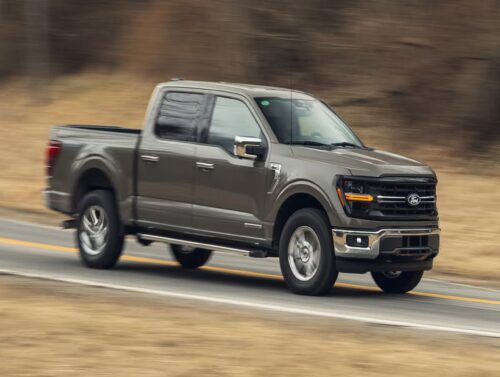
3.5L ECOBOOST, FIRST GENERATION (2011-2016)
COMMON PROBLEMS: Intercooler Condensation Stumble, Timing-Chain Pin Wear, Intake-Valve Carbon Buildup, Turbo Coolant O-Ring Leaks, Exhaust Manifold Stud Failure, PCV Adapter Leak
The intercooler condensation problem blindsides most owners on the first humid morning. The intercooler sits between the turbos and the intake, and on damp days moisture pools inside the charge pipe, so a hard pull spikes boost and the engine swallows that water as a slug. The truck stumbles, often stores a code, and in the worst cases it drops into limp mode, so we confirm the redesigned Ford air deflector is fitted before we look anywhere else. Timing-chain pin wear shows up as a cold-start rattle that won’t clear the way a loose accessory would, and a cam-to-crank correlation code tells us the chain has stretched past what the phaser can pull back. Carbon cakes the back of the intake valves because direct injection never rinses them, so we pull the manifold and walnut-blast the ports clean. The coolant quick-connect O-rings at the turbo lines harden and weep where you smell coolant without ever finding a puddle, and the cast-iron exhaust manifold studs back out of the aluminum head under heat cycling into a tick that shifts pitch as the engine warms.

3.5L ECOBOOST, SECOND GENERATION (2017-2020)
COMMON PROBLEMS: Cam-Phaser Cold-Start Rattle, Wastegate Rattle, Oil Consumption From PCV Overpressure, Charge-Air Boost-Pipe Leaks, Reduced Intake-Valve Carbon
Ford added port injection to the second-generation 3.5L EcoBoost in 2017 to rinse the intake valves the first generation never could, and that cut the carbon problem down. The engine still carries a cam-phaser rattle on cold start that Ford addressed through customer-satisfaction programs, and the correct repair ranges from a calibration update to a full phaser replacement depending on how far it has gone. A separate wastegate rattle reads as a metallic flutter at idle, and we localize it to the turbo housing rather than the valvetrain so the diagnosis doesn’t wander into the timing cover. On the high-output trucks, hard deceleration can pull oil past the crankcase baffle and burn it, and Ford issued a revised valve cover and calibration to settle that condition. We log oil level across a full interval before we ever call one of these engines a true oil consumer.
2.7L ECOBOOST (2015-2020)
COMMON PROBLEMS: Composite Oil-Pan Seal Leak, Cold-Start Turbo Smoke, Turbo Coolant-Line O-Rings, Heat-Damaged Sensor Wiring, Intake-Valve Carbon
The 2.7L EcoBoost runs a composite oil pan, and the seal between that pan and the block weeps as a film across the underside instead of a drip on the floor, so owners drive past it for months. We pressure-test the crankcase and read the pan-to-block seam before we condemn anything above it. The same engine can fire on a cool Santa Clara morning with a quick blue puff as oil seeps past the turbo seals overnight, then clears inside half a minute. The turbo coolant lines share the O-ring weakness of the larger EcoBoost, and heat soak under the intake can chafe the coolant-temperature sensor wiring into erratic readings that mimic a thermostat fault. We trace the wiring and the seal before replacing a sensor that tests fine on the bench.
5.0L COYOTE V8 (2011-2020)
COMMON PROBLEMS: VCT Cam-Phaser Rattle, Oil Consumption On 2018-And-Newer, Early Timing-Chain Tensioner Wear, Coolant Fitting And Water-Pump Leaks, Normal Valvetrain Tick
The 5.0L Coyote stays the most straightforward of the four, yet two faults still bring it to our lift. Its variable cam timing phasers rattle on warm restarts and through certain throttle transitions, and Ford issued a calibration to manage the oil flow that drives them. The trucks built from 2018 onward can burn oil between changes through the cylinder-liner process Ford adopted that year, so we log consumption across a full interval before we blame a tired bore. Early Coyotes can wear a timing-chain tensioner into a cold-start rattle, and the coolant fittings and water pump weep with age like any V8 under this duty. A light tap at idle is the engine’s normal injector and valvetrain noise, and we separate that from a real knock by when it shows up and how it changes under load.
5.4L TRITON V8 AND 3.7L TI-VCT V6 (2009-2014)
COMMON PROBLEMS: 5.4L Triton Cam-Phaser Rattle, 5.4L Triton Timing-Chain Rattle, 3.7L Oxygen-Sensor Wear, 3.7L Coolant-Fitting Seepage
The older trucks split into the loud one and the calm one. The 2009-2010 5.4L Triton V8 throws the loudest cold-start rattle, and it comes straight out of the oil system, because the cam phasers hold their timing on oil pressure and slip in the first seconds before the pump loads up. We trace cam position against crank position on a cold start with a scope, and the correlation tells us whether we’re chasing phaser wear, a stretched chain, or a tensioner bleeding down overnight. The 3.7L Ti-VCT V6 that arrived in 2011 is the calm one in this group, since its variable cam timing aged well and it rarely sets a phaser code. What the 3.7L does ask for is the occasional oxygen sensor and a watch on the quick-connect coolant fittings as the miles climb. Left to run, that short Triton rattle on a cold Willow Glen morning grows into a stored code and a teardown, so we catch it while it’s still seconds long.
TRANSMISSIONS: 6R80 AND 10R80
COMMON PROBLEMS: 6R80 Lead-Frame Circuit Failure, 6R80 Range-Sensor Recall, 6R80 Output-Speed-Sensor Dropout, 10R80 Harsh Erratic Shifting, 10R80 Multiple Shift Bulletins And Recalls
Two automatics sit behind these engines, and each one has its own tell. The 6R80 six-speed hides a lead-frame circuit inside the valve body that cracks with heat and scrambles its shifts, and it also carries a separate transmission-range-sensor recall, and the two read alike from the driver’s seat while needing different repairs, so we confirm which one before we quote. That same gearbox can drop its output-speed signal and throw the truck into a high gear without warning. The 10R80 ten-speed that arrived in 2017 hunts between gears, bangs a shift, and shudders on light throttle, and Ford addressed it across multiple bulletins and recalls. We verify the transmission control module is on the latest calibration before anyone talks teardown, because a reflash settles more of these complaints than a rebuild does.
KEEP THE TRUCK WORKING
A working F-150 can’t carry a failure that’s been building for six months, and every pattern above announces itself early if you know the sound. If yours is a first-generation EcoBoost that stumbles under hard boost, a 2018-and-newer 5.0L drinking oil between changes, or a 10R80 that bangs its shifts, bring it by while the fix is still small. A noise the truck didn’t make last month counts, and so does a shift that suddenly feels wrong. Call us at (408) 295-3786 and we’ll pull it in, read the engine and transmission you’re running, and give you a clear account of where it stands.
AREAS WE SERVE
DRIVEN
AUTO Care
Serving the South Bay AREA
Including: San Jose, Willow Glen, Santa Clara, Sunnyvale & beyond
Driven Auto Care has earned the trust of San Jose families, commuters, and business owners who need their vehicles running without excuses. We also serve Santa Clara, Sunnyvale, Milpitas, Campbell, and Los Gatos, which means we understand the mix of highway grinding and stop-and-go traffic that defines the South Bay. Your car is how you get to work, how you pick up your kids, and how you escape on weekends. We take that seriously.
to Excellence