 REVIEWS
We're Your Local Top-Rated Auto Repair Experts
Drive With Confidence
FORD EXPLORER REPAIR
YOUR LOCAL FORD EXPLORER REPAIR SHOP / TECHNICIANS / SPECIALISTS
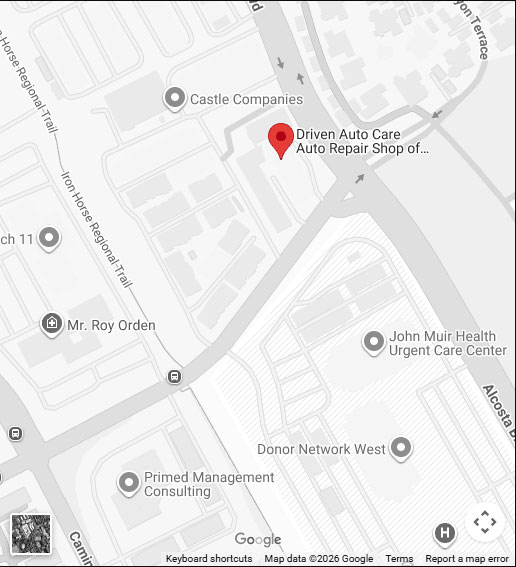
Serving the East Bay Area Including San Ramon, Dublin, Danville, Blackhawk & beyond.

On most engines the water pump bolts to the outside, where a worn one drips in plain sight. On the 3.5-liter V6 in 2011 to 2019 Explorers, that pump sits inside the engine, which changes the size of the repair. Explorers reach our San Ramon shop from across the Tri-Valley, and Driven Auto Care of San Ramon measures the fault before naming the part. Five repairs cover the ground most Explorer owners arrive with. The year, engine and drive layout narrow them to the one or two that fit yours.

— Let’s get started —

WATER PUMP INSIDE THE ENGINE
COMMON CONCERNS: Coolant You Keep Topping Up, A Gauge That Climbs On A Hot Day, A Small Drip You Have Watched For Months.
You keep topping the coolant, and the driveway stays dry. On the 3.5-liter V6 in 2011 to 2019 Explorers, the water pump sits inside the engine, turned by the timing chain. When that seal wears, coolant can escape through the pump's drain path or reach the engine oil, so the level may fall without an obvious puddle.
We pressure-test the cooling system, then read the oil on the dipstick. A change in color and texture is easy to see. Reaching the pump requires major timing-system access, so we inspect the chain, guides and tensioner and replace them only when their condition or the repair procedure calls for it. A loaner car or rideshare keeps you driving while the engine is open. Catching the loss early reduces the risk that contaminated oil or overheating will damage the engine.

TRANSMISSION SHUDDER AND HARSH SHIFTS
COMMON CONCERNS: A Rumble-Strip Shudder At Light Throttle, A Thump Into Gear, Hesitation Pulling Away From A Stop.
On 2011 to 2019 Explorers with the six-speed automatic, the usual complaint is a shudder at light throttle around 35 to 50 miles per hour. Owners describe it as driving over a rumble strip. The part that lets the engine and transmission slip smoothly at cruise carries a clutch, and as it ages that slip becomes a vibration.
On 2020 and newer trucks with the ten-speed, it is usually harsh low-speed shifts or hesitation. We road-test either one with the scan tool recording, so the symptom is captured against gear and lock-up data. From that data we can name the gear and the lock-up state the shudder lives in, and the repair is written to that.

THE ALL-WHEEL-DRIVE TRANSFER UNIT
COMMON CONCERNS: A Hot Gear-Oil Smell After Driving, A Whine That Rises With Road Speed, Fluid That Has Never Been Changed.
A hot gear-oil smell after a drive shows up on 2011 to 2019 Explorers with all-wheel drive. A front-wheel-drive Explorer doesn't carry the part at all. The box that sends power to the rear wheels is small, runs hot, and holds very little fluid. Ford built the early units without a drain plug or a dipstick. The fluid was never treated as a routine service item, so many are still on their original fill.
On the lift we look for a wet seam and check the fluid. We drive it and listen for what the whine follows, road speed or engine speed. Those two point at different parts. When the fluid comes out dark and burnt while the gears stay quiet, we service the unit and set a change interval.

SPARK PLUGS AND COILS
COMMON CONCERNS: A Misfire That Came Back After A New Coil, A Stumble Under Load, Oil Found Down The Plug Tube.
A coil that failed twice in the same cylinder usually has a wet tube underneath it. The plug sits at the bottom of a deep tube. Oil that gets past the valve cover seal runs down that tube and soaks the coil from below. A new coil dropped into the same wet tube fails the same way.
The plug comes out and we look down the tube before any new coil goes in. A dry tube points at the coil itself, and one swap between cylinders confirms it. A wet tube turns a coil job into a coil plus the leak that soaked it.

WHEEL BEARINGS AND FRONT-END WEAR
COMMON CONCERNS: A Growl That Changes When You Change Lanes, A Clunk Over Bumps, A Noise That Grew With The Miles.
A wheel bearing carries the weight of the truck while it spins, and an Explorer is heavy. When the bearing surfaces wear, they hum, and that hum rises and falls as the load shifts in a lane change. This shows up sooner on high-mileage trucks and on trucks that tow.
The joints and links that hold the front end wear the same way, and that clunk over bumps is what most owners notice first. On the lift we check the wheel for play and pry each front-end joint. A hum you notice at 45 miles per hour is worth a road test you can start on the way in.

"Very professional, Im a Auto technician mainly driveability. I could not work on my vehicle in my garage and the shop were i work not allowed. The Technician/owner is friendly knowledgeable just overall great experiance. Maybe when I retire could work there as a advisor a Nod to the team there. Thank you driven Auto team!"
Customer

"I found working with DRIVEN AUTO CARE to be an easy venture. John, the Service Mgr. has been in the auto service industry for a great many years and knows cars. He is easy to talk with and provides clear explanations (quotes) of what is required to repair your vehicle with costs. The usage of modern technology (e.g. text messaging) is easy to understand and the costs/options you can expect. GREAT customer service."
Customer

"Great service and honest! I appreciate having someone I can trust to not do more than what is actually needed! Since I have 3 vehicles, they have been there for me several times in the past year! Thanks John!"
Customer

AREAS WE SERVE
DRIVEN
AUTO Care
Serving the East Bay AREA
Including: San Ramon, Dublin, Danville, Blackhawk & beyond
Driven Auto Care serves San Ramon and the surrounding East Bay communities with quality repairs, clear communication, and a focus on long-term reliability. If you want a shop that gives honest answers (not mystery invoices), you're in the right place.
to Excellence